Survey code you can
read, diff, and trust.
The AI writes the first draft of the survey code. You review it, change it and own every line.
The AI drafts the code. You make the calls.
- 01 An IDE for surveys. Code, structure and live preview side by side. Readable YAML with Python-like logic, no drag-and-drop. See how ↓
- 02 Every AI change is a diff. Accept, refine or skip. Nothing is rewritten behind your back. See how ↓
- 03 No ceiling. Custom HTML, CSS and JavaScript at question, page or survey scope when the client wants bespoke. See how ↓
- 04 Free kit, freelance plan. Learn on the free developer kit. Solo is $59 a month for your own clients. Get the developer kit →
A grid is a grid.
Not a screen of markup.
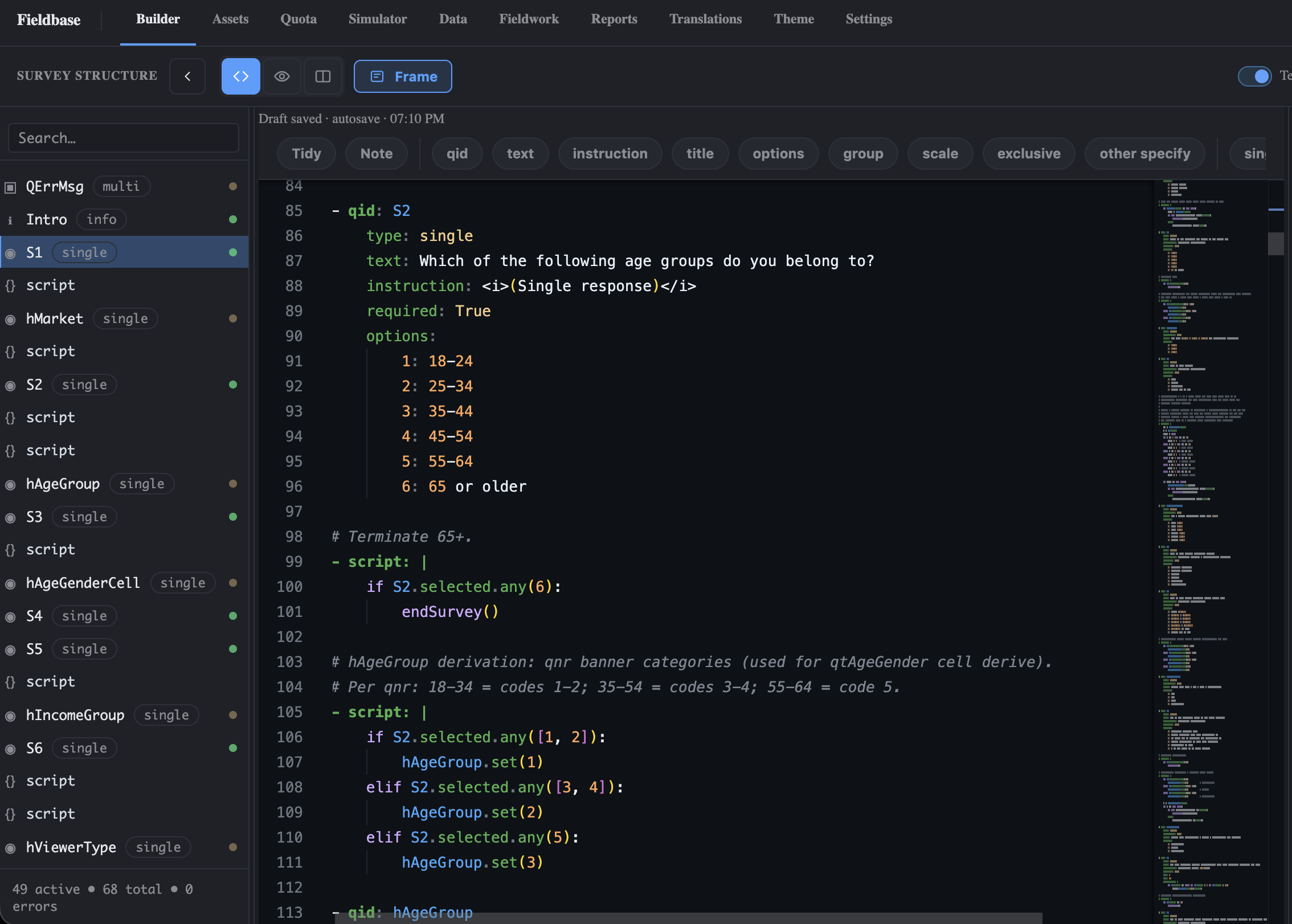
Fieldbase surveys are plain text: fifteen-plus question types, loops, piping and quotas in YAML, with routing and validation in Python-like script blocks. Version it, review it in a pull request, search it with grep.
- Python-like scripts. Routing, screen-outs, derived variables and cross-question checks in syntax you already read.
- A validator that runs first. Malformed branch conditions, orphaned references and invalid properties are caught while you type.
- Diffable by design. One question is one block, so a change review shows exactly what moved.
Ask for one change.
Get one block back.
The AI edits inside the block you are working on. The rest of the file is never part of its output, so it can’t quietly rewrite a question you didn’t mention. You see the diff with the validator already run, then accept, refine or skip.
- Scoped by construction. An edit to Q4 can only touch Q4.
- Validated before you see it. Every proposal is lint-checked, so a breaking change shows up in review, not in field.
- A record of every change. The project thread keeps each request, each diff and who accepted it.
 - qid: Q4
   type: multi
   options:
     1: Netflix
     2: Disney+
     3: Prime Video
+    99:
+      label: None of these
+      exclusive: True
+      anchor: True
Write the widget yourself.
It still reads and writes real answers.
Custom HTML, CSS and JavaScript run at question, page or survey scope. Question-level code is isolated in its own shadow DOM, page scaffolds expose slots for real questions, and theme tokens mean your widget picks up the client’s skin.
- Three scopes. A single question, a page layout with slots, or the whole survey.
- Isolated by default. Shadow-DOM isolation keeps your CSS out of the rest of the survey.
- One write path. Widgets read and write answers through the same API, so the data file stays clean.
What changes in your day.
The same study you would have programmed anyway, with the hand-coding removed.
- Morning
Review the draft
The AI has drafted the survey from the questionnaire. You read it like a pull request.
- Midday
Do the hard parts
Custom routing, quota gates, the widget the client asked for. The parts that need you.
- Afternoon
Simulate
Hundreds of simulated respondents through every route. Fix what was never reached.
- Next day
Hand over test links
Every language from the same build, validator clean.
Try it on your own machine first.
The developer kit is free and works offline with the same validator the platform uses.
- 1 Download the developer kit
The full language reference, a zero-dependency linter and ready-made bundles for Claude, ChatGPT and Gemini.
You do this - 2 Rewrite one study you know well
Take a questionnaire you programmed last month and compare the result line for line.
You do this - 3 Bring it onto the platform
Paste it into the Builder to get the preview, simulator, quotas and exports around it.
You do this - 4 Get your agency onto the cohort
If it saves you the hours, point your team at the Launch Cohort. We programme their first two studies with them.
We do this
The honest answers.
Is this going to automate me out of a job?
It automates the hand-coding. The judgement calls stay with you: interpreting ambiguous programming notes, complex routing, quota design and custom widgets. Programmers on Fieldbase take on more studies, not fewer responsibilities.
How long does the syntax take to learn?
If you have scripted a survey before, the YAML reads on day one and the script blocks read like Python. The developer kit includes the full reference and a linter you can run locally.
Can I keep surveys in version control?
Yes. A survey is a text file. Commit it, branch it, review it in a pull request and grep across every study you have written.
What if the AI gets it wrong?
Then you skip or refine the proposal. Every change is a reviewed diff scoped to one block, the validator runs before you see it, and nothing applies without an accept.
Which question types are built in?
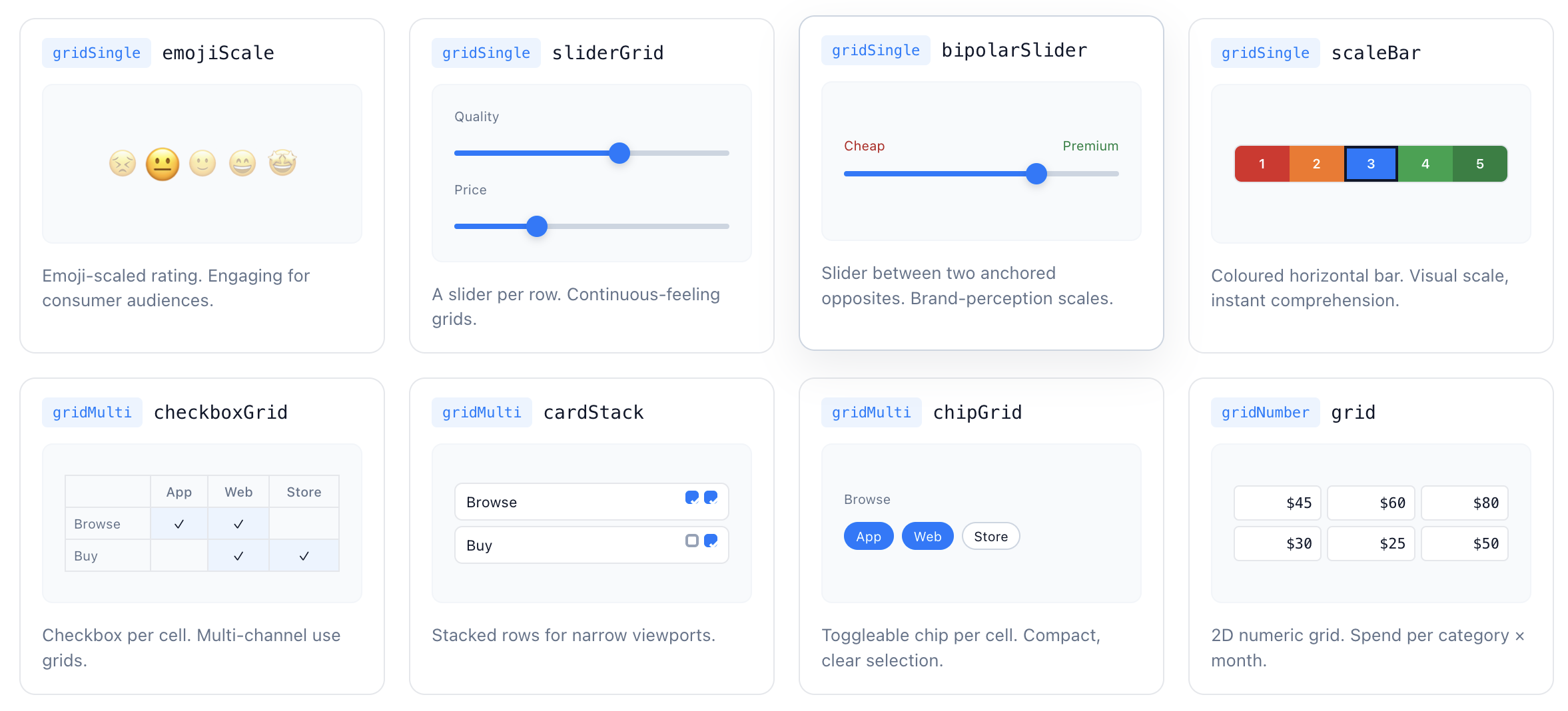
Fifteen-plus types including single, multi, grids, numeric lists, rank, card sort, lookup, CBC and MaxDiff, with around sixty skins between them.
Don’t take the page’s word for it.
Run your next three projects free.
Up to 5,000 completes over 90 days, hosted in the US (EU coming soon). We programme the first two questionnaires with you; you programme the third with the AI. At day 60 we talk about staying, with a 24-month price lock.