Serious choice modeling.
Transparent math.
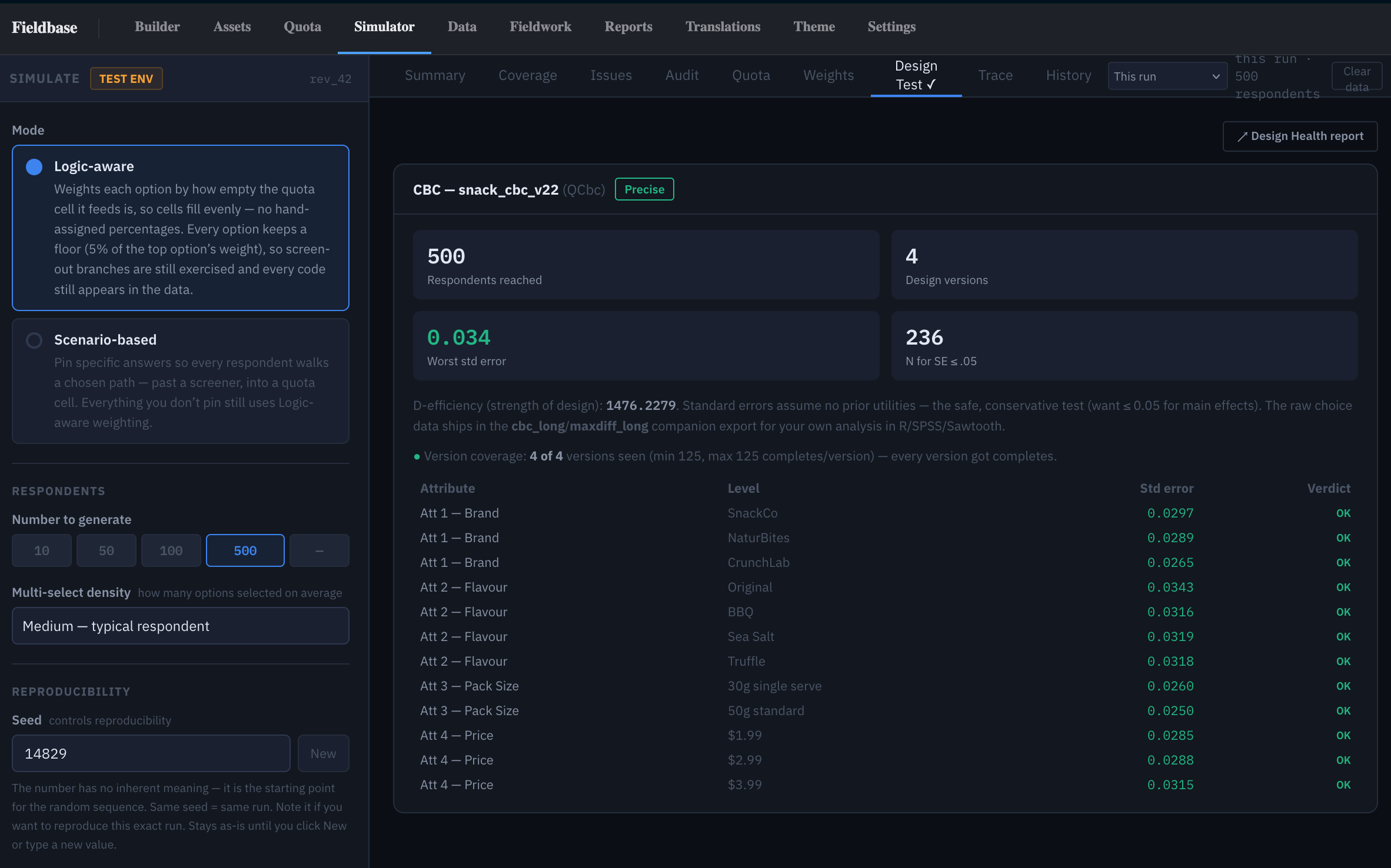
CBC and MaxDiff with the design test built in — Design Health, Precision scorecards, D-efficiency, implied-N. Know the design will produce usable utilities before the panel bill arrives.
CBC + MaxDiff + Design Test
Designs live as versioned project assets, analysis runs in-app, raw datasets export clean for downstream tools (Sawtooth, R, Python).
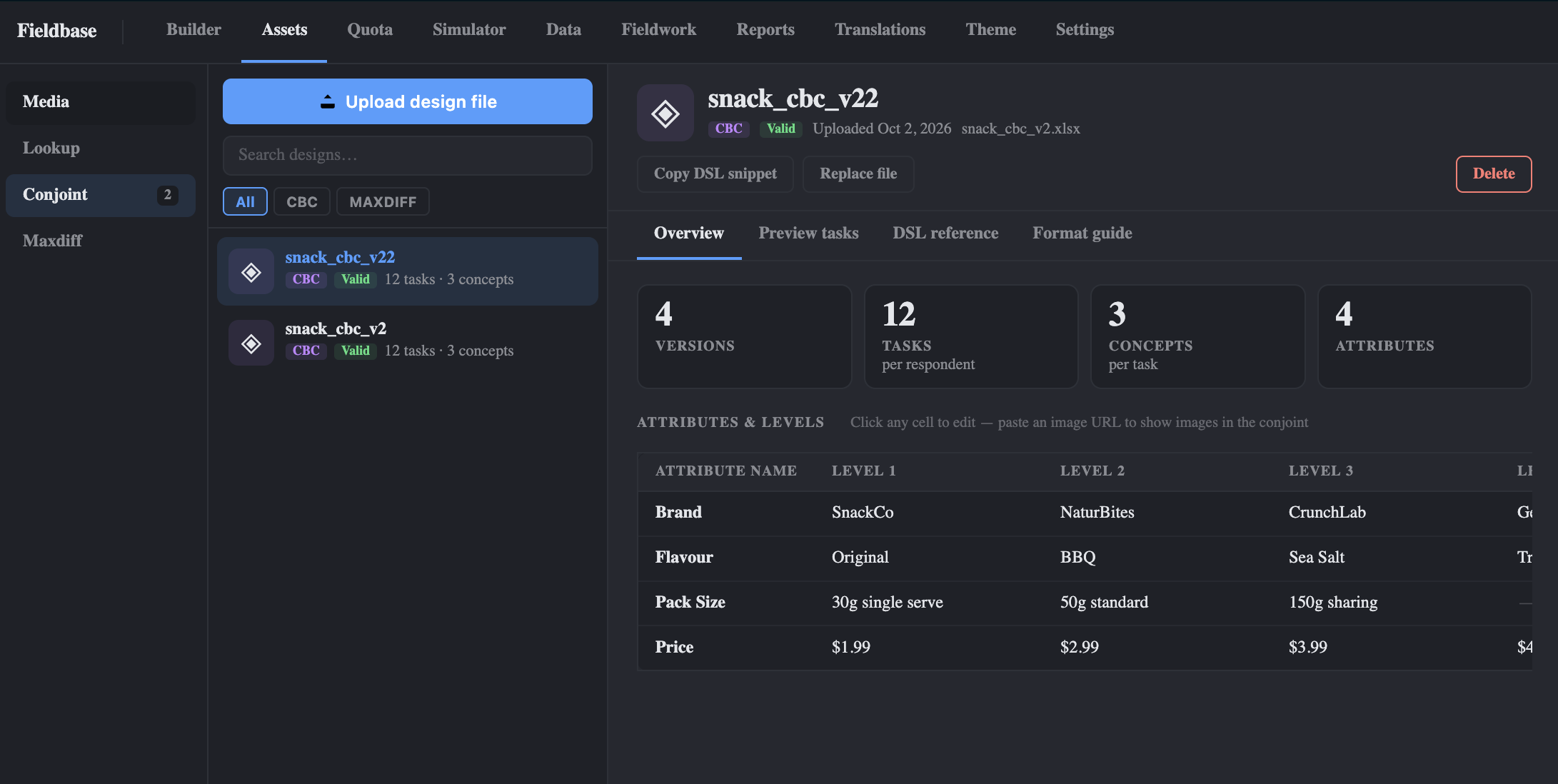
CBC design files
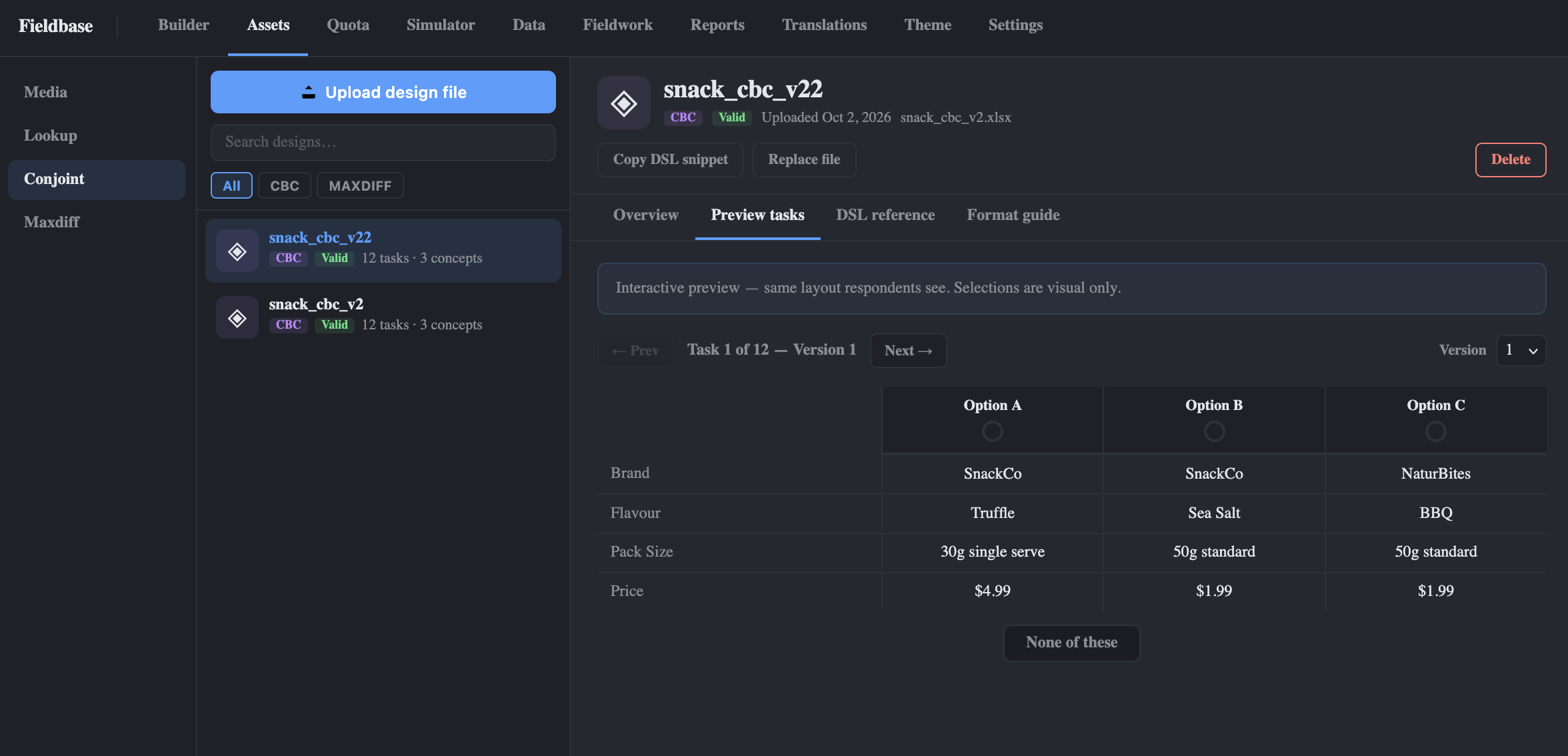
Upload a Sawtooth-format design or a CSV of concept matrices. Fieldbase parses it, verifies the design covers all respondents fairly, previews individual tasks for QA, and exposes it as a project asset:
- qid: QCbc
  type: cbc
  design: project://laptop_cbc_v2
  response_mode: choice
  none_of_these: True
Aggregate MNL logit part-worths run in-app (effects-coded,
Newton–Raphson), with level importance derived from utility
ranges. In-task follow-ups (why did you pick this?)
surface alongside the part-worths. A live share-of-preference
simulator (softmax over utilities) lets you flex attribute
levels and watch share move in real time. The cbc_long
dataset exports cleanly for Hierarchical Bayes in Sawtooth, R,
or Python.
MaxDiff exercises
Same upload flow. Fieldbase computes best-worst scores, preference share, and TURF analysis in-app with by-segment comparisons. Rescaled scores export cleanly for downstream modelling.
- qid: QMaxDiff
  type: maxdiff
  design: project://brand_attrs_v1
  items_per_task: 4
  tasks_per_respondent: 10
Design Test — know before you field
Two scorecards sit next to the design in the editor:
- Design Health — level exposure counts, accidental-prohibition flags, version-coverage evenness. Red / amber / green verdicts, no conjoint-stats background required.
- Precision — per-level standard errors from the aggregate MNL information matrix, D-efficiency, and the implied-N needed to hit a target SE.
The scorecards update in real time as you edit the design — add
a level, change a prohibition, bump the task count, see the
precision shift. The cbc_long and
maxdiff_long datasets export alongside the
scorecards so a statistician can re-verify in Sawtooth, R, or
Python.
Balanced version assignment
Set versionSource: systemBalanced and the engine
assigns the design version for every respondent — balanced
±1 by construction, herd-free under
concurrency, reproducible across reruns. One line in the
module, nothing to script, no screener to maintain.