The shortest list that
reaches the most people.
TURF (Total Unduplicated Reach and Frequency) answers the question every brand team eventually asks: if we can only pick a few, which few cover the most people? On Fieldbase, TURF runs on your MaxDiff data in-app — slide the set size from 1 to N, read the reach, see which item each step adds and how much extra reach it brings. The greedy build-up is confirmed optimal for the chosen size via exhaustive search, so you know the set you're reading isn't just the first one the algorithm stumbled onto.
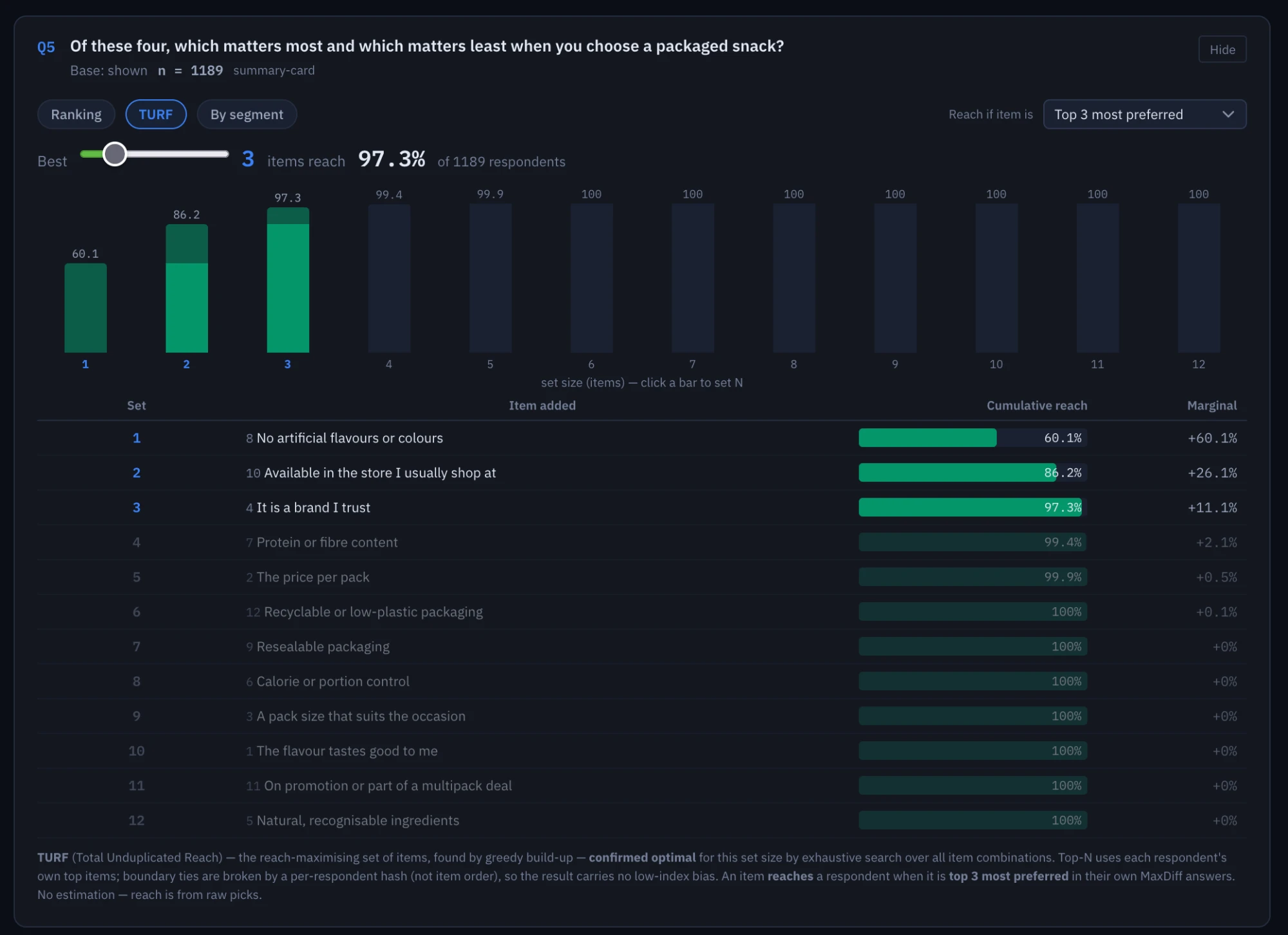
3 items. 97.3% of respondents.
Pick a set size on the slider; the reach bar and the per-step table shift under it.
A set size of 1 reaches 60.1% of the panel. Adding a second item lifts reach to 86.2%. A third gets you to 97.3% — and after that each extra item is worth less than a percentage point. The chart on top is every set size from 1 to 12 so you can see the shape of the curve; the table underneath shows exactly which item each step adds and how much extra reach it buys.
Which shortest list wins?
The question comes in a dozen shapes. The answer is the same shape every time.
A menu team wants the five dishes that keep the most customers happy. A product manager wants the four SKUs that cover the widest audience. A marketing lead wants the three messages that hit the broadest segment. TURF is the tool that answers all of them — and because it sits inside your MaxDiff project, you don't have to export and reshape to run it.
Rule of thumb: look for the point on the reach curve where the next item adds less than a percentage point or two. That's the natural cut-off — and the number of items you can quote with a straight face when a stakeholder asks why five, not six?.
Greedy build-up, exhaustive optimality check.
The set you read is actually the best for its size — not just the one the algorithm found first.
Greedy TURF — pick the item that reaches the most people, then the item that adds the most new people on top of it, and so on — is fast and usually right. "Usually" isn't good enough on a brand decision, so Fieldbase re-checks the greedy answer against every possible combination at that set size. If a different set reaches more, it's used; if greedy was already optimal, the result is labelled confirmed optimal so you know.
TURF analysis, in plain terms.
What does TURF stand for?
TURF stands for Total Unduplicated Reach and Frequency. Reach is the share of respondents covered by at least one item in the chosen set; frequency is how many items in the set a respondent is covered by. The method is sometimes also written Total Unduplicated Reach Frequency — the "and" is often dropped in casual usage, but the full name is the one Charles Miaoulis coined when he popularised the technique in the 1970s.
What is TURF analysis?
TURF (Total Unduplicated Reach and Frequency) is a method for finding the shortest set of items — products, menu dishes, features, messages — that reaches the most people in a population. It's typically run on MaxDiff data, using each respondent's top-ranked items as the basis for reach.
How does TURF analysis work?
TURF builds the reach-maximising set one item at a time using a greedy algorithm: pick the item that reaches the most people, then the item that adds the most new people on top of it, and so on. Fieldbase re-checks the greedy result against every possible combination at that set size using exhaustive search, so the final set is confirmed optimal.
When should you use TURF analysis?
Use TURF when the deliverable is a short list: menu simplification, product-line decisions, feature prioritisation, or picking the few messages that cover the broadest audience. The natural stopping point is where the next item adds less than one or two percentage points of extra reach.
What's the difference between TURF and MaxDiff?
MaxDiff produces a preference ranking: which single item is most preferred, second-most, and so on. TURF uses that ranking to answer a different question: which set of N items covers the most people? MaxDiff tells you what wins; TURF tells you the shortest list that works.
What software can run TURF analysis?
TURF is available in Sawtooth Lighthouse, Displayr, Q, and some SPSS extensions. Fieldbase runs TURF in-app on MaxDiff data with a set-size slider, by-segment cuts, and exhaustive-search optimality — and exports the raw maxdiff_long dataset for Hierarchical Bayes work in Sawtooth, R, or Python when you need it.
TURF beside the MaxDiff, where it belongs
TURF on Fieldbase lives one tab over from the MaxDiff
ranking that feeds it — same project, same respondents, same
segment definitions. Pick the set size, pick the Top-N
preference threshold, pick a banner cut, read the reach.
When a stakeholder asks why that set?, you can show
them the per-step marginal reach that got you there. The
raw maxdiff_long dataset exports clean too, if
anyone wants to re-verify in Sawtooth, R, or Python.