What-if share-of-preference.
In the room.
A share simulator a brand team can drive without a stats consultant. Pick levels for Product A and Product B, add more products as the conversation turns, watch Predicted Share of Preference move in real time. Built straight on the aggregate utilities, with the outside-option (None) in the mix so the numbers reflect "would they even buy?" and not just "which did they pick?".
Build the products, read the share.
One row per attribute, one dropdown per product, one share bar per product.
Each attribute gets its own row; each product gets its own
column. Levels in the dropdowns carry their part-worth so
a brand team sees why a move helps or hurts
(SnackCo (+0.01), BBQ (−0.06)).
Flip a level, the bars underneath move with you.
Include-None is on by default — turn it off for a captive
scenario, leave it on when you want share you can actually
quote.
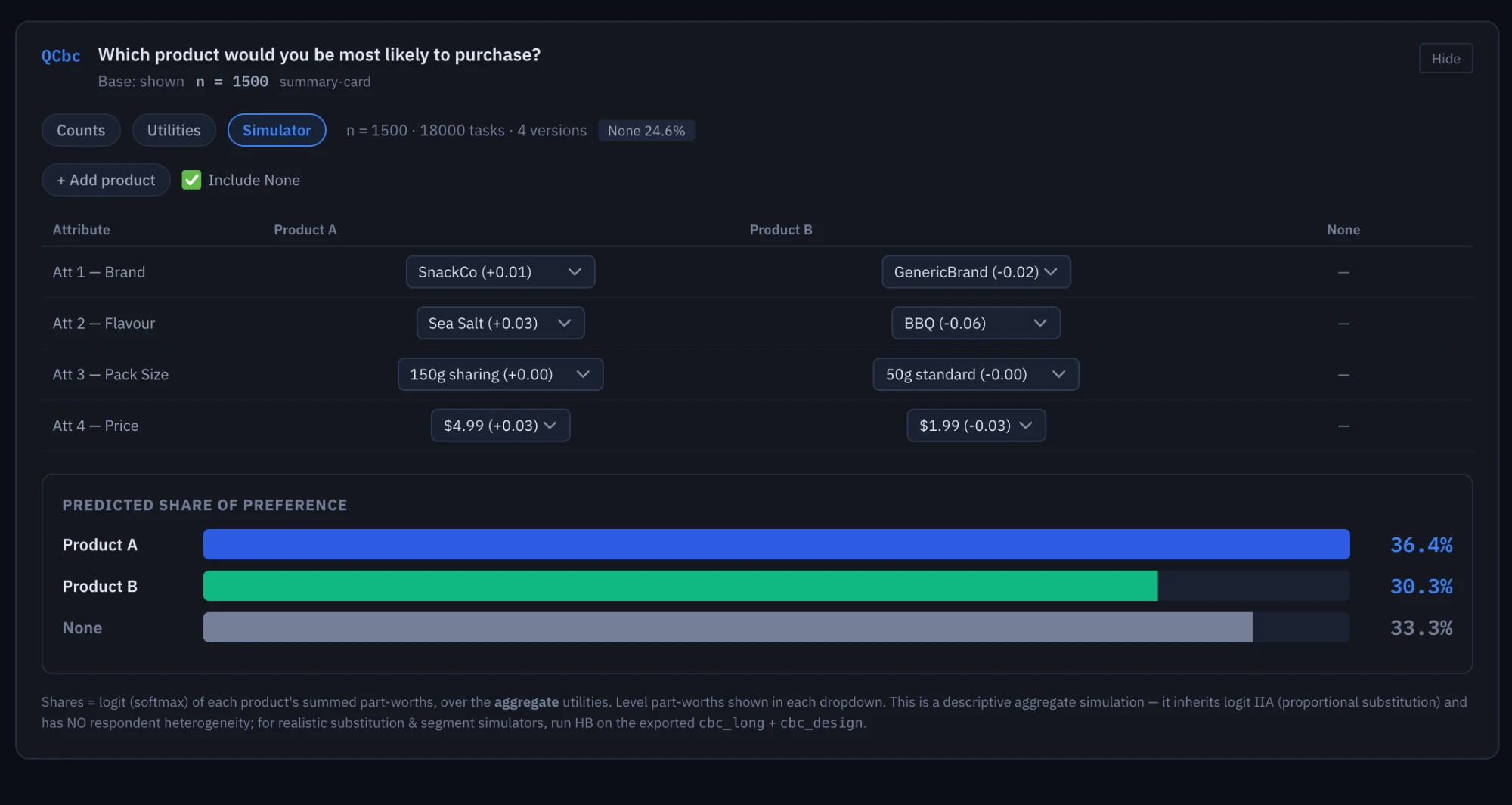
Softmax over the aggregate utilities.
What the engine does under the hood, in a sentence.
For each product you build, Fieldbase sums the part-worths of its levels into a single utility. That utility goes through a softmax alongside the other products (and the None constant, if it's in the mix) to land each product's predicted share. One dataset. One model. Live math.
- Aggregate utilities. The simulator runs on the same part-worths you see on the Utilities page — no second fit, no second truth.
- Add product. Two is the default; add a third, fourth, fifth with one click. Each one gets its own column, its own share bar.
- Include None. Toggle whether the outside option competes with your products. On by default, so the shares reflect real market behaviour; off when you want captive scenarios ("if these were the only two…").
- Level part-worths in the dropdown. Each option shows its utility (
+0.03,−0.06) so a brand team sees why a move helps before they pick it.
For realistic substitution, run HB.
Honest about what it is — and about what to reach for when you need more.
This simulator is an aggregate fit, which inherits logit IIA (proportional substitution): drop a product and the share redistributes proportionally across the rest. Fine for most brand conversations; not fine for segment-level what-ifs or realistic cross-elasticities. For those, export the raw dataset and run Hierarchical Bayes.
- Live "what-if" with a brand team in the room
- Ballpark share estimates on new combinations
- Checking that aggregate utilities tell a coherent story
- Teaching stakeholders what the utilities mean
- Segment-level share forecasts
- Realistic substitution (brand switching, loyalty)
- Cross-elasticity work
- Anything where IIA would mislead a planning decision
cbc_long + cbc_design export in one click — straight into Sawtooth Lighthouse, R's bayesm/ChoiceModelR, or Python's pyLogit.
The simulator a brand team can actually drive
Most conjoint simulators sit in a stats tool only the analyst can open. Fieldbase's lives in the Reports module, next to the counts and the utilities, so the conversation about "what if we lowered the price?" happens with the brand team in the room and the number updating on screen. Honest about what it is (aggregate · IIA), honest about what to reach for when you need more (HB on the exported dataset), and close enough to real market share for most of the questions anyone will actually ask.