Know your design works.
Before you spend on panel.
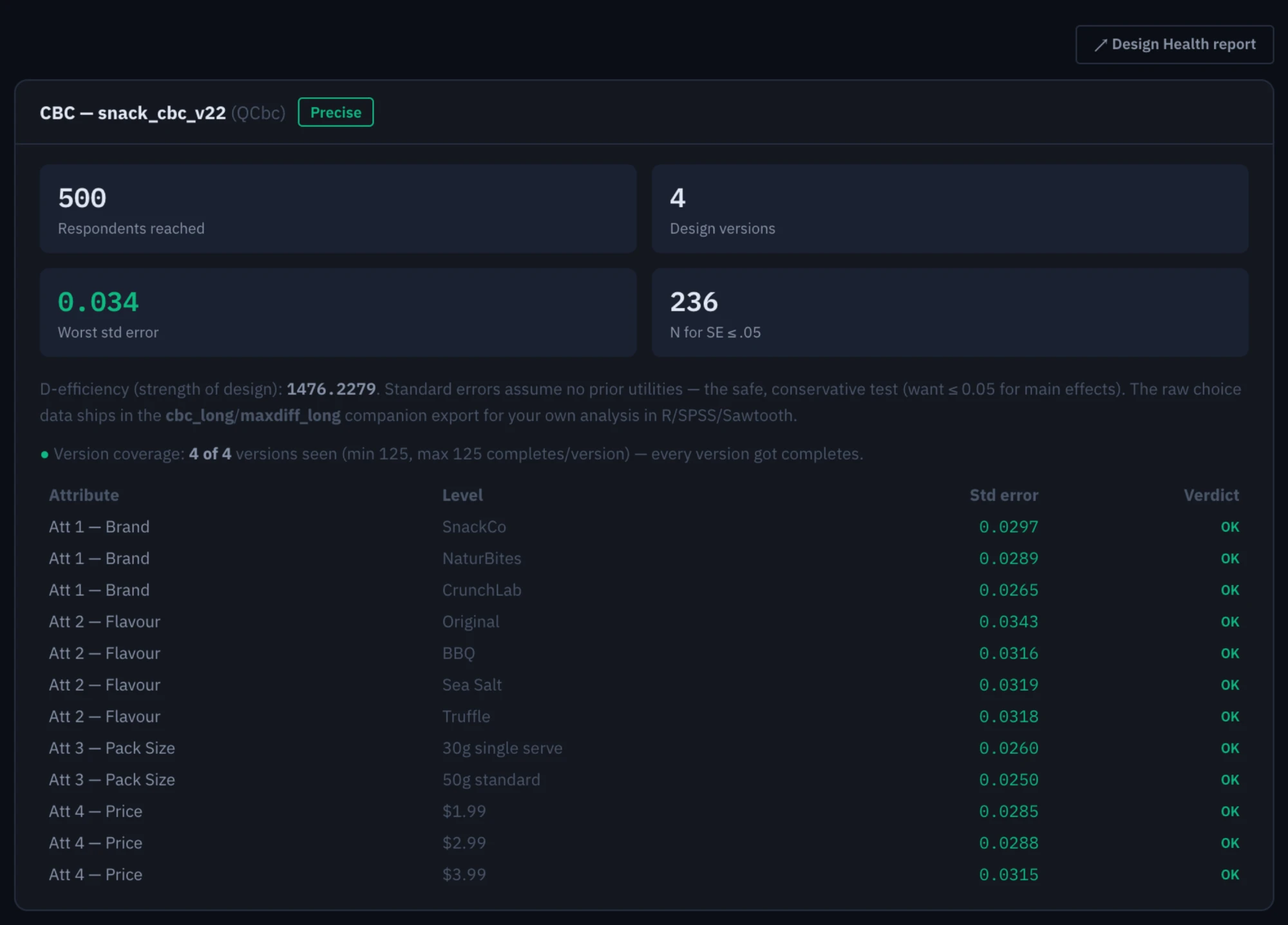
Two scorecards sit beside every CBC and MaxDiff design in Fieldbase. One tells you the design is valid — level exposure balanced, no accidental prohibitions, every version covered. The other tells you it'll be precise enough — per-level standard errors, D-efficiency, and the sample size you'd need to hit a target SE. Both update the moment you edit the design, so you know whether you need another task or another hundred panelists before you've spent a cent.
Precise, Caution, or Underpowered.
A single word at the top of the card — then the four numbers that explain it.
The headline of every Design Test card is a plain-English verdict. Precise means you're good to field at the sample size you planned. Caution flags something that'll bite under certain analyses. Underpowered says you won't get usable utilities on at least one level without a bigger panel. The four tiles under the verdict — respondents reached, design versions, worst std error, and the sample size you'd need to hit SE ≤ .05 — tell you why in one glance.
Two cards. Two questions.
Is the design valid? Will it be precise enough?
Design Health answers the first. Precision answers the second. Together they catch the two ways a conjoint design can disappoint — a layout error that corrupts the whole analysis, or a correctly built design that just doesn't carry enough information to pin down the levels you care about.
- Level exposure — is every level showing up enough times?
- Prohibition flags — did a level you banned slip into a task?
- Version coverage — are all design versions reaching panel?
- Per-level standard errors from the MNL information matrix
- D-efficiency — the strength of the design overall
- Implied N — the sample size you'd need to hit a target SE
Change the design. Watch the numbers move.
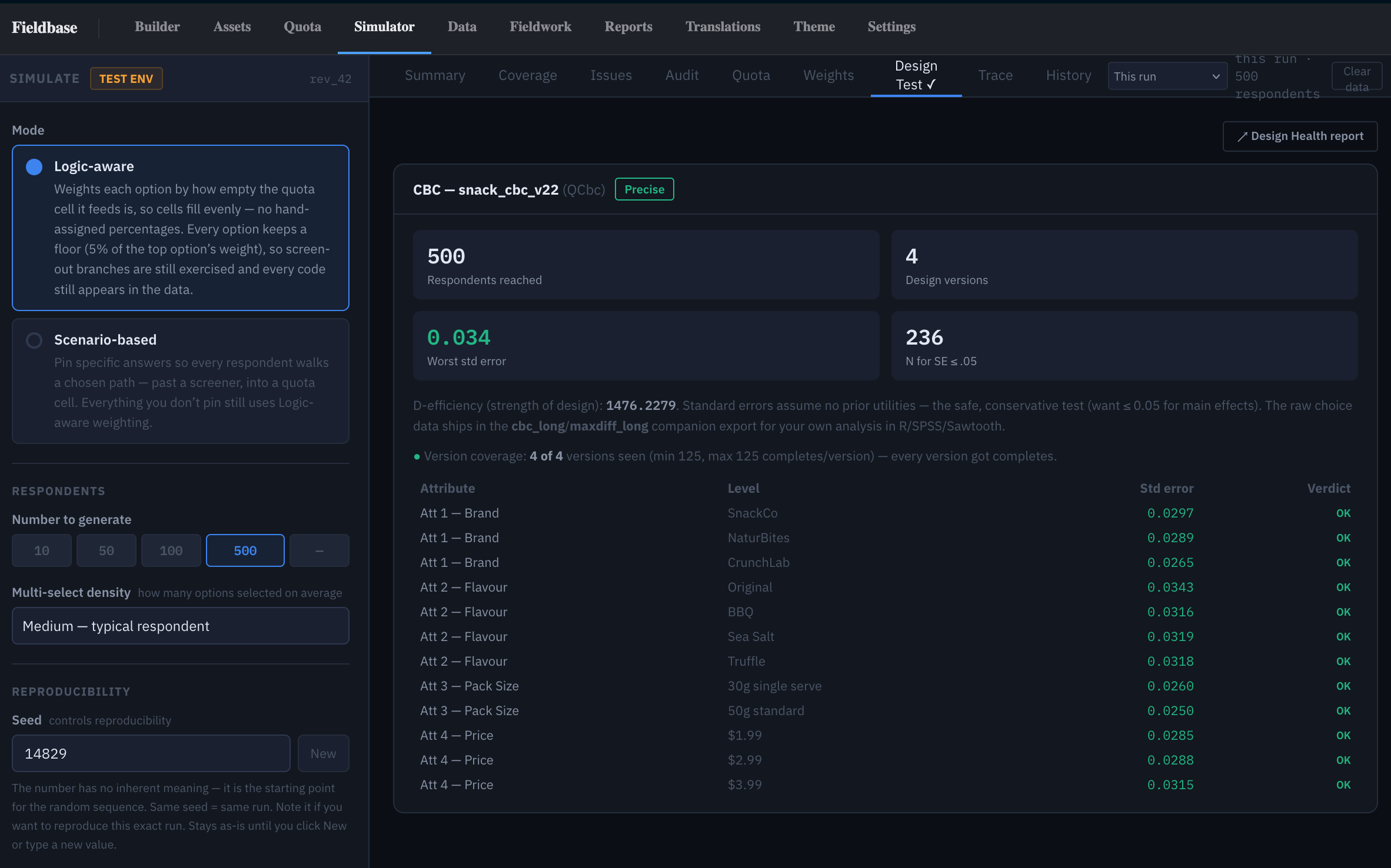
Add a level, bump the task count, flip a prohibition — the scorecards shift under you.
The feedback loop is seconds, not days. Fieldbase recomputes the scorecards every time you touch the design, so you can try things — more tasks per respondent, fewer attributes, tightened prohibitions — and see whether the fix lands before you commit to a brief, let alone a panel buy. Shown below: three edits on the same CBC design and how each one moved the verdict.
Catches the two ways a conjoint design can fail you
A broken design and an underpowered one look identical in
field — respondents complete, data arrives, utilities come
out. The difference shows up when the brand team asks the
first follow-up: why is this level flat? or can
we trust the price curve? Design Test catches both
before anyone writes a brief. The cbc_long and
maxdiff_long datasets export alongside the
scorecards, so your statistician can re-verify in Sawtooth,
R, or Python if they want to.